
Ergonomic gaming chair: Hope or just another marketing promise?
Do you know that feeling...?
I'm sitting at my desk, the coffee's still warm, the code is running smoothly – and yet I've already shifted in my chair three times in five minutes. My shoulders are hunched forward, my neck is stiff as a board, and there's that dull ache in my lower back that I've almost started to ignore.
Worked for eight hours. Then played a round of video games. And at the end of the day, I don't feel 34 – but like someone who has mistreated their body for years.
I actually thought I had done everything right.
I finally got an ergonomic gaming chair .
At least that's what it said everywhere.
But if I'm being honest:
The longer I sat, the more restless I became. My concentration waned. I got irritated more easily while gaming and made mistakes I never would have made before. Eventually, this thought crept in, quietly and really hurting: Maybe I'm simply the problem.
The inconvenient truth
“Ergonomic” is one of the most frequently used – and at the same time most frequently misused – words in chair marketing.
I experienced it myself.
In just a few years, I bought three chairs. All were supposedly ergonomic. All were supposedly "made for long periods of sitting".
- One was from a German brand; it seemed high-quality, and the marketing was good. But the seat was too short . I'm 1.86 m tall, and the chair was supposedly suitable for people up to 1.90 m. That sounded good. However, the seat depth was n't adjustable . The result: pressure on my thighs, no support, and constant sliding forward.
- Two other chairs were cheaper; they were classic imported chairs. On one of them , the faux leather started peeling off after two years . Black crumbs were everywhere – on the floor, in the carpet, and on socks – and they were almost impossible to remove.
- The armrest on the third chair broke after a year and a half . There was no replacement part or service available. Tough luck.
And they all had one thing in common: they were sold as ergonomic gaming chairs.
What nobody told me back then, and what I only understood much later, is that ergonomics isn't created by a label. It's created by adjustability.
If a chair cannot be adjusted to the body, it is not ergonomic – regardless of what the product text says.

Written by Max Ritter on December 17, 2025
Software Developer | Gamer
How I got out of the “endless sliding around” – and finally understood what my body was trying to tell me.
At first, it seemed almost harmless.
A bit of aches and pains after long days. A stiff neck after an intense ranked session. I thought: "Just normal. I sit a lot. It'll pass."
But then came this tipping point.
Every workday – restlessness while sitting.
Every evening – the LWS (lower back pain) makes itself known.
During every longer phone call, her shoulders were raised and her jaw tense.
And when gaming? That was the worst. I couldn't focus properly anymore. Not because the game was difficult, but because my body kept interfering.
I typed, leaned forward, back again, forward again. I changed my sitting position like other people change tabs in a browser. For a moment it was okay, then it came back: that dull feeling in my back, as if an alarm was going off somewhere inside. Not loud. But constant.
I thought, "This will pass."
Instead, it became more frequent.
There's one evening I'll never forget: I finished work later than planned, grabbed a quick bite to eat, and then played "just one more round" of video games. I hadn't been sitting down for 20 minutes when I experienced that typical scenario: my shoulder blade slumped, my neck stiffened, and I felt pressure in my lower back, causing me to unconsciously tense my abdominal muscles. I could really feel myself getting irritated—not by the game, but by myself.
That was the first time that unpleasant thought occurred to me.
Maybe I'm just sitting in the wrong place.
Even worse: Maybe I'm just not made for sitting for long periods.
But I'm a software developer! My job involves sitting for long periods.
And I'm not the type to be blinded by marketing. I've even bought "ergonomic" chairs. A German brand, no less. Despite that, I felt like my body was handing me the bill every night.
That's when I realized: This isn't just "a few muscle tensions".
That's stress – not mental, but physical. Constant tension. Micro-pains. Restlessness. And all of that eventually affects focus, mood, and performance.
The good news is: if you understand why a so-called ergonomic gaming chair isn't ergonomic for you, you can make targeted changes – without the placebo effect, without "just sit up straighter" nonsense, and without telling yourself you just need to pull yourself together more.
The moment I understood why sitting felt so "rigid".
Looking back, there was one point that I had completely overlooked for a long time.
I always thought that a chair where the backrest moves backwards was automatically ergonomic, but that's not the case.
My first two chairs could "rock." When I leaned back, the whole chair tilted backward. To me, that was movement. And honestly, it even felt quite good at first.
But I only got tired after sitting for several hours a day. The explanation is logical once you know it:
For example, if I drive on the motorway for eight hours, I'm tired afterwards, even if I moved around briefly during breaks. This is due to my posture: I sit firmly in a bucket seat, similar to the rocking seat of many gaming chairs. When driving, centrifugal forces act on me, holding me in this position. These forces aren't present when sitting at a desk – yet I remain in this rigid posture day after day.
From an ergonomic perspective, this static sitting is problematic because it doesn't allow for any movement in the pelvis, hips, and spine. The hip flexors aren't stretched, not all day. Every single day. Ergonomics experts emphasize that largely static sitting increases the strain on muscles and joints and reduces blood circulation. This was explained to me back then with a simple image: a garden hose .
If you kink the hose, no water flows. If you open it, everything can flow freely again.
And it's exactly the same with the fluids in our body – with blood, lymph fluid and the supply of muscles and tissues.
If the body remains rigid in one position, this "tube" will be permanently kinked in a figurative sense.
Only through genuine opening and closing of the body – that is, through movement while sitting – can everything flow again.
Therefore, dynamic sitting , which involves movement and changes in position, counteracts this and promotes blood circulation and muscle activity. Both are factors that can reduce long-term fatigue.
Only when I understood what was really happening and why did I realize that this simple rocking motion hadn't done me any good in the long run.
The first chair with a synchronous mechanism – and why it immediately felt different.
The first chair where I thought, "Okay, something different is happening here" , was a German chair that I looked at very closely – but which I ultimately did not buy .
It was the first time I had encountered a synchronous mechanism .
Even during the initial test sitting, it felt different from anything I had experienced before.
When I leaned back, the entire chair no longer moved as a single unit. The backrest opened up my upper body – and the seat moved synchronously, but slightly offset .
Suddenly I had the feeling that my body was opening and closing again .
Not abruptly, but smoothly.
I noticed immediately:
- The hip was relieved of pressure.
- The back could straighten.
- The blood flow felt more active.
- I tensed up less unconsciously.
For the first time, I truly understood what is meant by movement while sitting .
The reason why I didn't take him anyway quickly became clear:
The seat was too short for me – and its depth could not be adjusted.
So I finally had the right mechanics, but not the right geometry for my body . My thighs were basically sagging. I could clench two fists between the seat and the back of my knees. Way too much.
In retrospect, that was a crucial aha moment:
Good mechanics alone are not enough.
An ergonomic gaming chair must allow movement – and at the same time have so many adjustment options that it adapts to the body .
Why rocker mechanism and synchronous mechanism are not the same
Today I know:
Most gaming chairs on the market – certainly 90% or more – use a rocking mechanism .
That means:
- The seat and backrest move together
- The body tilts, but does not open.
- The pelvis remains rigid, and is even rather sloping, as most of the seating surface tilts backwards.
A synchronous mechanism, on the other hand:
- The backrest and seat move in a coordinated manner, but differently.
- changes the hip angle
- enables micro-movements
- promotes blood circulation and relief
Or, put more simply: With a rocking mechanism, the chair moves.
In synchronous mechanics, the body moves.
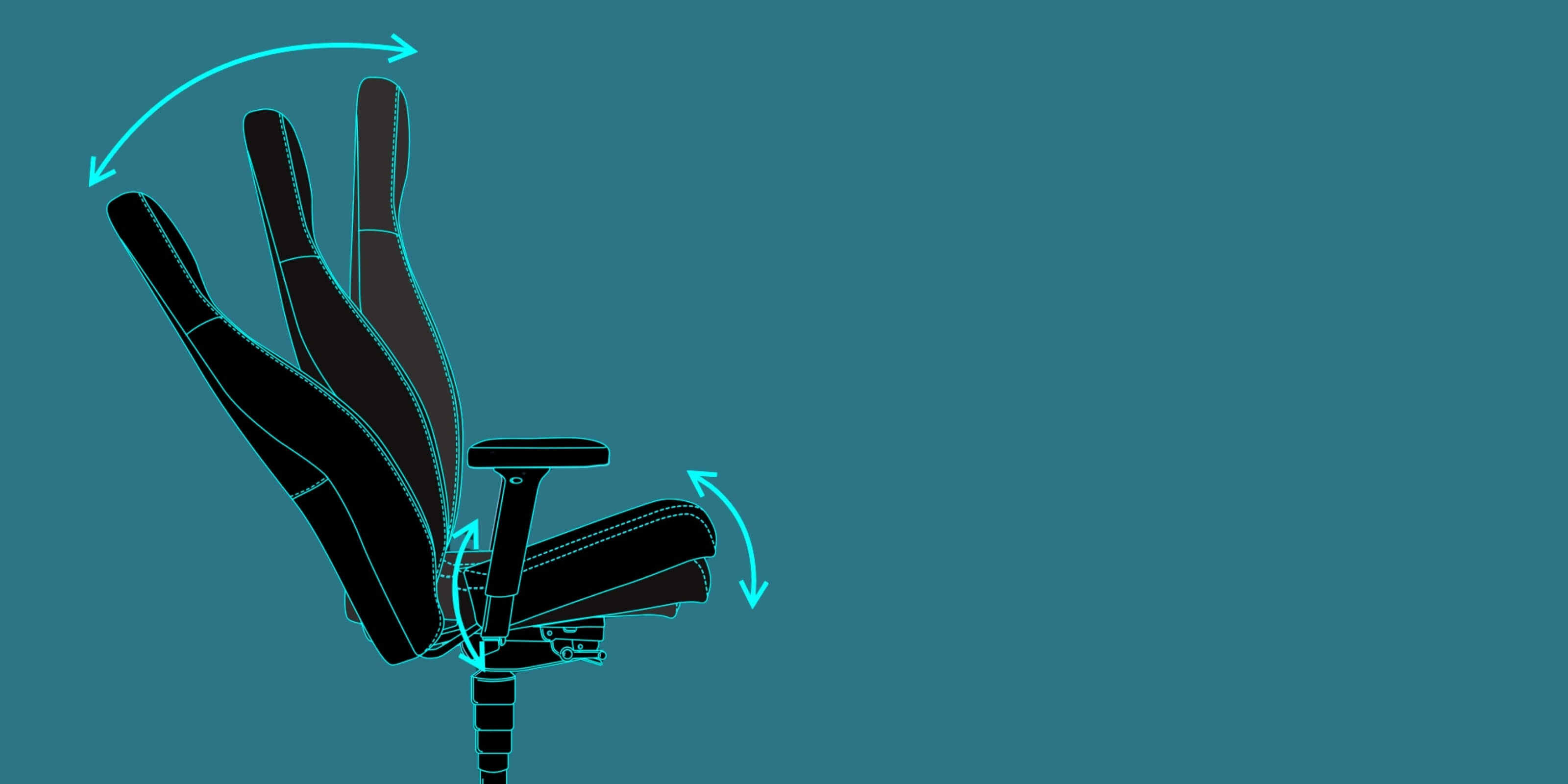
The seat and backrest are linked,
but they move in different proportions to each other,
to promote active sitting.
Why does sitting sometimes feel like constant stress?
There are two sides:
Normal sitting
Briefly, with movement in between, changing positions.
The body adapts, the muscles work, and blood circulation remains active.
When you stand up, everything is okay again. No lingering tension. No inner resistance.
Stress-related sitting
And then there's the other way of sitting.
This is something many of us are familiar with from working from home and gaming.
You are sitting in a neutrally heated room, actually quite comfortable – and yet:
- You keep sliding back and forth.
- The shoulders hunch up.
- The neck becomes stiff.
- My lower back is bothering me.
- Your legs become restless.
- You find it difficult to focus.
Not after 8 hours.
But after 20-30 minutes.
Your body never rests – even though you're hardly moving.
The technical term behind it (and why it's important)
What's happening here is not a "wimp problem".
This is a stress-induced, sustained activation of the nervous system .
If a chair does not support the body correctly, micro-postural problems can occur:
- The pelvis tilts slightly backwards.
- The lumbar spine loses its natural lordosis.
- Your core muscles are constantly tense to "hold you up".
The nervous system interprets this as instability.
👉 Result: positive activation
(The same mechanism is activated in cases of stress or alarm.)
Simply put: Your body is internally in "hold or resist" mode – even though you actually want to relax.

EXPERT KNOWLEDGE
The role of the HPA axis during sitting
The so-called HPA axis
(Hypothalamus – Pituitary gland – Adrenal cortex)
It controls the release of cortisol – the long-term stress hormone. Prolonged poor sitting posture means:
- constant muscle tension
- The spine is not relieved of pressure.
- There is no true relaxation while sitting.
The result:
- Cortisol levels remain elevated.
- Regeneration does not occur.
- Exhaustion sets in more quickly.
And that's exactly what you feel. Not as acute pain, but as restlessness, irritability, and loss of concentration.
Risks that many underestimate
Chronic tension
Chronic tension leads to hardened muscles, especially in the neck and lower back. Touch becomes unpleasant, and stretching only provides short-term relief.
Mental fatigue
When the body constantly has to "counter" stress, it lacks the energy for thinking. Focus, problem-solving, and reaction speed suffer, which becomes noticeable at work and while gaming.
Lack of regeneration
Anyone who gets up from their chair in the evening and doesn't feel "refreshed" but rather empty is accumulating a kind of sitting-sleep debt . The body never really winds down.
Creeping resignation
At some point you stop thinking:
"The chair doesn't suit me."
but: "I'm just sensitive."
And that is precisely the most dangerous point.
Have you ever noticed that in the evenings you feel tired for no apparent reason?
- Do you constantly change your seating position?
- or unconsciously raise your shoulders?
- clenches his teeth?
- Or that you need to "straighten up" after getting up? These are not minor things.
Your nervous system is sending clear signals that your sitting posture is not ergonomic – regardless of what the product data sheet says.
My turning point came when "home remedies" for sitting were no longer sufficient.
I tried everything you try when you think you can somehow solve the problem yourself.
More breaks.
Ergonomics YouTube.
"Sit up straighter."
Standing desk phases.
Back stretching between two calls.
Another mouse.
Different keyboard.
Seat cushion.
Lumbar support.
It helped briefly. Then the next wave came.
The real problem is:
All these measures only treat the symptoms, not the cause. They provide temporary relief, but they don't recalibrate your sitting posture. If the chair doesn't support the body correctly, the body has to compensate permanently.
- The postural muscles remain active.
- The pelvis tilts unconsciously.
- The spine is not relieved of pressure.
Your nervous system stays in alert mode – even when you're "actually sitting still." I told myself for a long time that I just needed to be more disciplined. More exercise. More mindfulness. More "proper sitting." But then one evening came when I realized:
This is no longer normal.
I sat, stood up, sat down again. No position lasted longer than a few minutes. I had pressure in my lower back, my shoulders were hunched, and my neck was tense. I was tired, but not relaxed. And irritable at the same time. That's when it hit me: if I don't address the root cause , "a little uncomfortable" will turn into a chronic sitting problem .

EXPERT KNOWLEDGE
Classification: When sitting becomes stressful
What many people don't know:
Prolonged poor sitting posture does not immediately manifest as pain .
Typical signs include:
- constant repositioning and sliding
- Tension in the neck without a clear cause
- Rapid fatigue during work
- Loss of concentration
- the feeling of needing to "straighten up" after getting up
Important – and this is crucial:
If there is no acute orthopedic issue (intervertebral disc, acute inflammation, etc.), it is worthwhile to systematically question the sitting itself .
Not the duration of the sitting.
Not the discipline.
But the chair.
What my research has shown me
I started to really read up on it. Not marketing texts – but occupational medicine, ergonomics guidelines, and studies. And I noticed something that's surprisingly rarely clearly stated online:
An ergonomic gaming chair is only ergonomic if it adapts to your body – not the other way around.
Specifically, according to occupational science recommendations (including DIN EN 1335, BAuA, ergonomic guidelines of the DGUV), this means:
An ergonomic chair must:
- have an adjustable seat depth (thigh support without pressure),
- provide active, adjustable back support and
- Armrests that are adjustable in height , width and depth ,
- Stabilize the pelvic position instead of forcing it.
- Allowing movement while seated instead of rigid fixation.
Without these qualities, there is no relief – no matter how expensive or “certified” a chair is.
At this point I understood:
I don't need another "almost ergonomic" chair. I need one that truly functions as an ergonomic gaming chair – technically, biomechanically, and in the long term.
To be honest, I was close to abandoning the whole thing. Not because I didn't care about my back, but because all the solutions sounded the same.
Improved ergonomics.
More comfort.
More settings options.
And then you click through reviews that read like they've been copied and pasted. Five stars, superlatives, hardly any substance. I caught myself thinking:
"Either everyone here is lying – or I'm simply not compatible with chairs."
And it was precisely during this phase that I came across Gamechanger . A small German startup. No aggressive marketing. No price wars. Few reviews – which initially made me rather skeptical.
But: all verified .
And above all: different in content .
It's not about finding the "most comfortable gaming chair ever," but about making very specific statements about ergonomics, seating mechanics, and adaptation to the body .
What convinced me professionally, not emotionally, was what convinced me.
I didn't look at the marketing, but at the construction. That's when I realized: This isn't just "gaming design with an ergonomic veneer," but a genuine ergonomic gaming chair, designed from the inside out. The key points for me were:
- Adjustable seat depth
Finally, full thigh support without pressure in the back of the knee.
no more sliding forward -
Active backrest with genuine lumbar support
No plastic lumbar support, but a pre-shaped backrest that adapts to my back without being fixed in place. - 4D armrests
Height, width, depth, angle adjustable
My shoulders could finally stay relaxed – especially while typing and gaming. - Size concept instead of "one size fits all" from S to XL, adapted to body size and proportions, no more compromise on seat height or backrest length
In short:
The chair doesn't force you into a posture – it helps you find your own .
Mechanics – explained in everyday language
What made the difference for me wasn't "more cushioning". It was the less work required .
My body suddenly needed:
- no longer permanently stabilize.
- can no longer compensate.
- and no longer work against the wrong levers
The seat supported me. The backrest followed. The armrests provided relief, thanks to an instructional video that explained exactly how to adjust the chair to your body. And that's precisely what caused something unexpected to happen.
I became calm while sitting.
Not consciously. Not "forcedly ergonomic." But automatically.
How it went for me
Weeks 1–2
I've noticed that I no longer constantly change position .
In the evenings I had less tension in my lower back. After getting up, I no longer had to stretch.
Weeks 3-4
I can complete long coding sessions without feeling that inner pull. When gaming, I have significantly more focus – not because I've improved, but because my body isn't interfering anymore.
Weeks 6–8
My shoulders are more relaxed and my neck is significantly less stiff. I sat longer – but paradoxically, without fatigue .
Weeks 9-12
Normality. I no longer constantly think about sitting. No frustration. No "I'm just sensitive."
What really felt like a switch flipped for me was this:
When the sitting position is correct, the entire system calms down.
An ergonomic gaming chair is not the solution because it is expensive or bulky.
But because it supports the body in its work – and not against it.
What is special about Gamechanger and how does it differ from other "ergonomic gaming chairs"?
I asked myself that very question. Very critically, in fact. Because, quite honestly , everyone claims to be ergonomic.
So I didn't ask:
"What makes you better?"
rather:
"Why does your approach even work?"
The answer was surprisingly matter-of-fact – and precisely for that reason convincing.
The key difference: system instead of individual measure
Many chairs solve one problem in isolation :
- soft seat
- high backrest
- stylish armrests
Gamechanger takes a different approach. They consider the interplay of all contact points with your body. Because sitting isn't a single component. It's a system comprised of the pelvis, spine, arms, and movement .
Why this combination works
1. Seat depth + seat height = pelvis in balance
The adjustable seat depth ensures that:
- the thighs are worn
- no pressure is created in the back of the knee.
- the pelvis does not tilt backwards
Without a correctly positioned pelvis, there is no ergonomic sitting posture . Period.
2. Backrest that works with you – not fixed
Instead of forcing you into a rigid position, the backrest dynamically supports the natural shape of the spine.
This reduces holding tension – and therefore stress.
3. Armrests for support, not decoration
4D armrests are not a gimmick.
Correctly set:
- The shoulders slump
- the neck relaxes
- Hands and forearms are supported
This is especially important when typing and gaming.
4. Concept of size instead of average person
Gamechanger doesn't think in terms of "it'll do," but in terms of proportions.
L and XL are not marketing terms – they make biomechanical sense.
In short
Don't just "pad away" the symptoms.
But rather eliminate the cause of restlessness while sitting .
When your body no longer needs to constantly stabilize,
The internal level automatically decreases.
Is Gamechanger really better than other ergonomic gaming chairs?
I hesitated for a long time.
I already had some experience – including with a German brand.
What made the difference:
- Genuine seat depth adjustment (not a fake slider)
- Spare parts & service instead of a disposable product
- Transparent communication instead of buzzwords
- Verified reviews , not inflated
- Made in Germany , verifiably so, not just claimed.
Many chairs appear ergonomic, as long as you test them briefly .
The difference becomes apparent after:
- 4 hours
- 8 hours
- Weeks
- years
And that's exactly what an ergonomic gaming chair is for.
The price objection – completely justified.
Yes, Gamechanger is not a €299 solution.
But at some point I did an honest calculation:
- three chairs in just a few years
- Back pain
- Productivity loss
- frustration
- bad evenings
That costs more – financially and mentally.
I'd rather invest in a chair once,
which can be used for 15 years ,
instead of starting over again and again.
The effect objection
Ergonomics is not a feeling.
It is measurable and explainable .
Occupational health recommendations (e.g. DIN EN 1335, BAuA, DGUV) agree:
Without seat depth adjustment, adjustable back support and correctly positioned armrests, no sustainable relief is achieved.
Gamechanger fulfills exactly these requirements – no more, but also no less.
The everyday objection
I'm not the kind of person who spends 15 minutes every morning fiddling with levers.
The good:
Once the chair is properly adjusted , it disappears from your mind.
And that, for me, is the strongest indicator of quality:
I no longer think about sitting.
And the signal of trust
I'm not the only one who's had this experience.
Others report:
- less back pain
- more relaxed working
- longer, more focused sessions
Not euphoric.
But it makes things easier.
And I am honestly happy to be able to say today:
I am no longer sitting against my body – but with it.
That's exactly what an ergonomic gaming chair should do.
Tip & honest recommendation
Do you feel caught out because you get up from your chair in the evening and think:
"Why does it feel like this again?"
Restlessness while sitting. Pulling in your back. Loss of concentration – even though you're actually doing everything "right"?
Then that is not a sign of weakness.
It's a sign that your sitting posture isn't suited to your body .
If you don't want to buy another "almost ergonomic" chair, but a truly ergonomic gaming chair that provides long-term relief instead of creating new problems, then take a closer look at Gamechanger.
Not as an impulse buy.
But as a conscious decision for:
- true seat depth adjustment
- a concept of size instead of average
- sustainable materials & spare parts
- ergonomic design based on occupational health principles
- Made in Germany, built for many years of use
👉 Start now, while your body can still switch gears quickly.
The sooner your posture is correct, the easier it is for your system to calm down again.
The extra touch that tipped the scales for me
- Individual configuration (size, material, color)
- Try it out near you – no blind purchase
- Long-term spare parts supply instead of a disposable product
- Transparent guarantee & service
And yes: This is an investment.
But one that pays off every single workday .
👉 Click the button and find out more about the Gamechanger – the ergonomic gaming chair that not only sounds good, but actually works.
If you take one thing away from this article, let it be this:
Ergonomics doesn't begin with marketing.
It begins where your body finally stops fighting.
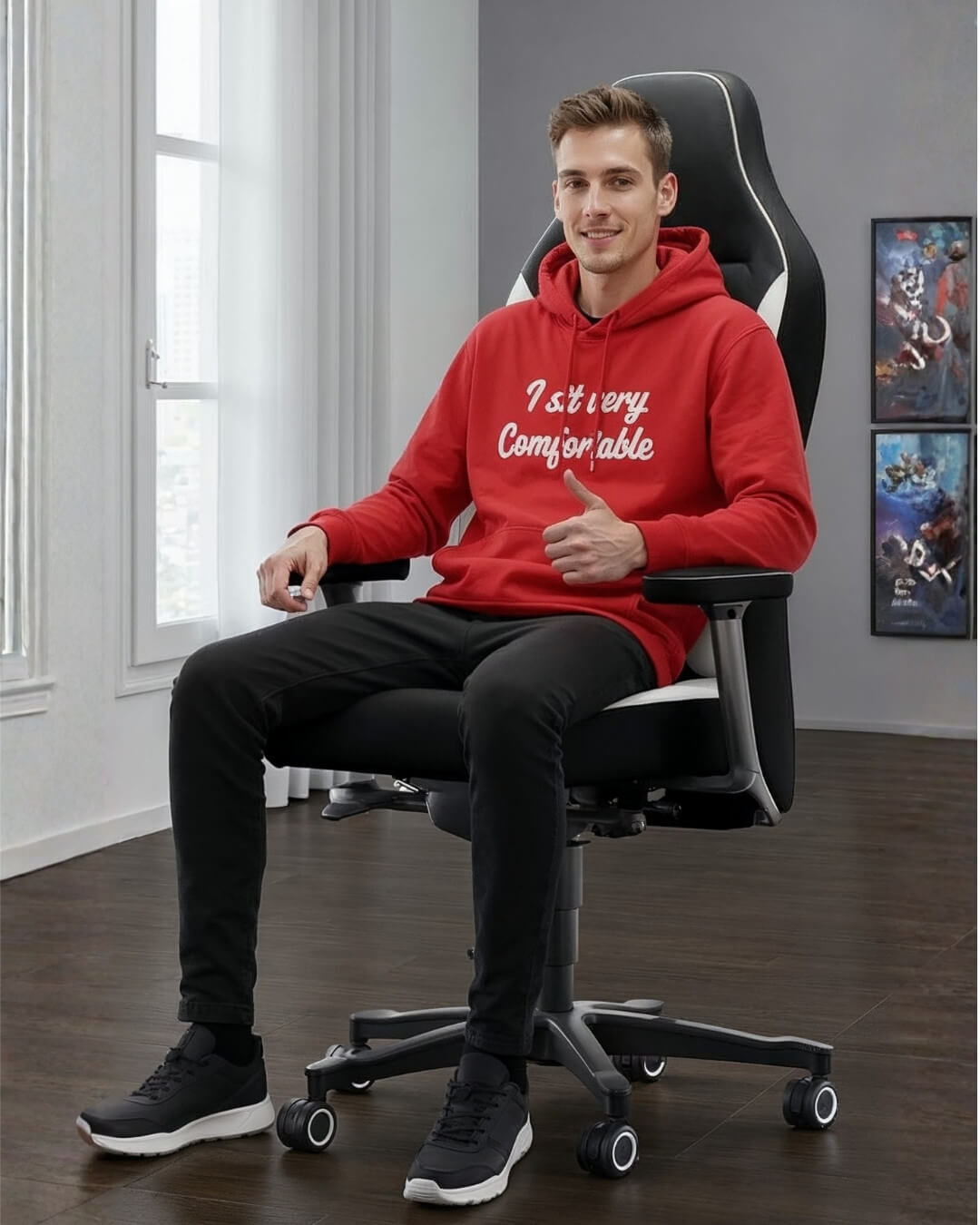
Finally, ergonomic seating!
✅ Breathable synthetic leather, no sweating
✅ Feels like real leather, wipeable
✅ Synchronous mechanism for ergonomic seating comfort
✅ Customize size, material and options
Frequently asked questions about ergonomic gaming chairs
What makes a gaming chair truly ergonomic?
A gaming chair is only ergonomic if it can be adjusted to the body. Key features include adjustable seat depth, height-adjustable backrest, at least 4D armrests, and the correct size.
Is an ergonomic gaming chair better than an office chair?
Not automatically. Many gaming chairs are purely design products. An ergonomic gaming chair combines office chair ergonomics with support for extended sitting times and active posture – only a few models can do that. If your gaming chair doesn't have a synchro-tilt mechanism, it's not ergonomic!
How long does it take to notice the difference?
Many people notice less restlessness while sitting after just a few days. Lasting relief is usually noticeable after 2–6 weeks.
Why are many ergonomic gaming chairs still uncomfortable?
Because they don't adapt sufficiently to the body. A lack of seat depth adjustment is one of the most common reasons. A non-height-adjustable backrest and the absence of a contoured back are the second most common reasons.