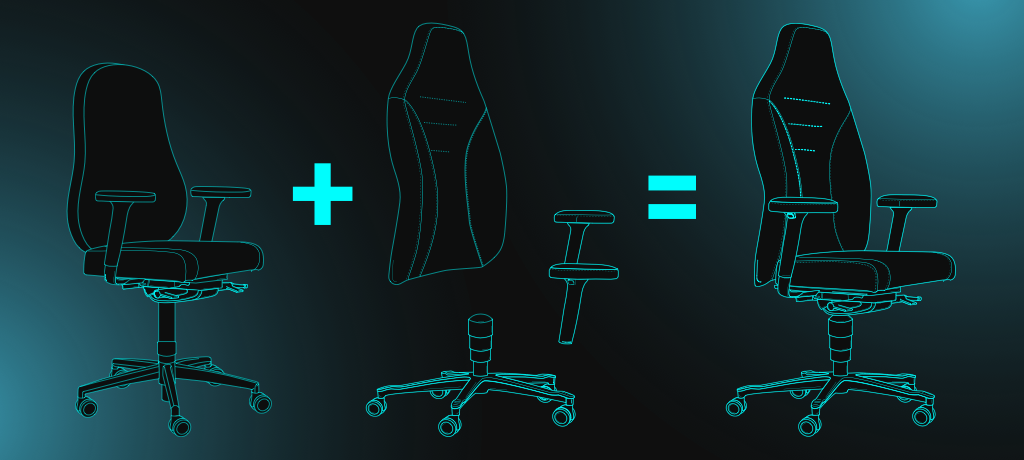
Anyone who delves into the details of office chairs or gaming chairs will eventually encounter the technical product specifications and wonder: Tilt mechanism? Synchronous mechanism? What? 🤔
Especially when you're shortlisting two gaming chairs, you might find that they use different mechanisms, leaving you unsure which one is better or what they're capable of. The most common mechanism is probably the rocking mechanism, while a few models, like the Gamechanger gaming chair, are equipped with a synchro-tilt mechanism .
What are the differences between synchronous and rocking mechanisms, and why did we choose a synchronous mechanism for Gamechanger ? Find out now – let's get started!
The rocking chair among mechanisms

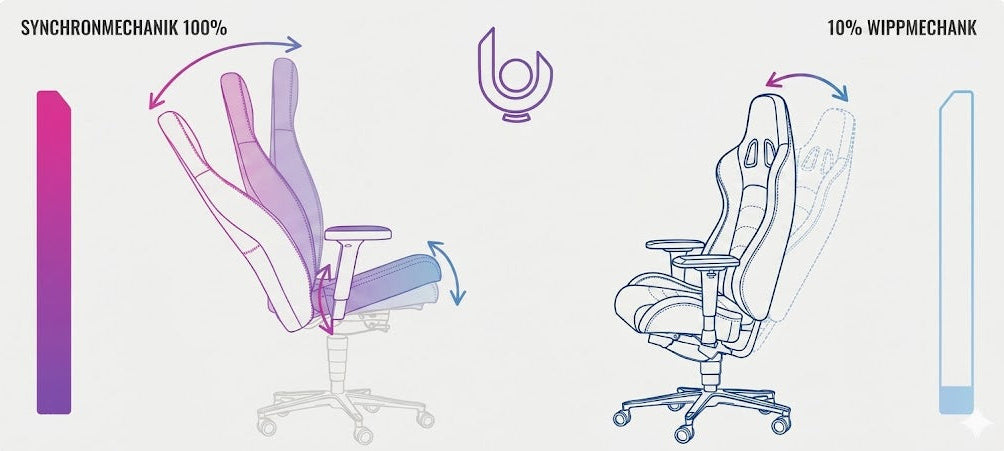
The tilt mechanism can be considered a kind of rocking chair among mechanisms, because here the backrest and seat are consistently linked . This means that when you lean back, the backrest remains at a fixed angle to the seat. This also means that the angle between your torso and legs doesn't change and remains constant.
It is precisely this consistently identical opening angle that causes problems when sitting for extended periods . When you lean back, the rear of the seat lowers while the front rises. The seat moves much like a seesaw. However, the counter-movement to your buttocks is now your much lighter legs, whose knees lift, causing your feet to leave the ground. Getting back up from this position requires a similar effect to getting up from a very deep, sunken-in chair. You use a rather dynamic movement originating from your lower back and pelvis. And it is precisely this complex sequence of movements that is problematic for your back in the long run .
As soon as you try to straighten up again, you lose the support of the backrest and thus valuable support for your spine. During the described movement, your back momentarily detaches completely from the backrest, and your lower back alone does all the work for you. This brief moment is enough, however, to cause you to assume a poor posture, which can manifest itself in the form of painful tension .
The reason for this lies in the tipping point, or rather the pivot point, of the tilt mechanism. Often this is located in the middle of the seat, or there is only minimal pressure from the backrest. You therefore have to manually return your seat to the upright position. While there are tilt mechanisms whose pivot point is located at the front edge, thus allowing for individual adjustment of the backrest pressure, the effort required for your back remains high, and nevertheless, a significant disadvantage remains:
Because the angle of your pelvis remains constant, optimal blood and lymph circulation is not guaranteed . Furthermore, your abdominal organs cannot "breathe" properly and are compressed within your pelvic cavity. Therefore, if you spend all day "stuck" in your gaming chair with a rocking mechanism, these organs are compressed and cannot function properly, which can be particularly problematic for your intestines.
The synchronization mechanics

For a dynamic seating experience with plenty of freedom of movement, the synchronous mechanism is ideal. Here, the backrest is flexibly linked to the seat . When the backrest is tilted, the seat tilts backward to a lesser extent. For example, with a synchronous mechanism, if the backrest is tilted backward by 10°, the seat tilts downward by 5° with a 2:1 ratio. A 3:1 ratio is also possible with a synchronous mechanism. In contrast, with a rocking mechanism, the ratio is always 1:1. The synchronous mechanism thus ensures a greater opening angle in the pelvic area . For a brief comparison: In its resting position, the Gamechanger offers an opening angle of 90°, which can be extended up to 32° – depending on how far you lean back. At its maximum tilt, the seat has an incline of approximately 8.5°. The advantages at a glance:
- When you lean backward, your feet maintain contact with the ground.
- The higher opening angle relieves pressure on your blood vessels in the pelvis - blood circulation is maintained.
- Your musculoskeletal system is activated: both your back extensor muscles and your joints are moved by leaning back. Your pelvis remains balanced.
But the synchronous mechanism has another advantage over the rocking mechanism: the support for your spine remains constant. When you want to straighten up from your comfortable, reclined position, minimal effort is required from your abdominal muscles. The pressure of the backrest also supports your forward movement, ensuring that contact with the backrest is maintained.
The game changer in ergonomics
You can probably already guess: For our Gamechanger gaming chairs, the synchronous mechanism offers numerous advantages over a rocking mechanism. An ergonomic gaming chair has a specific task: It should act as a relief mechanism, ensuring that your work situation at your desk doesn't negatively impact your body – whether that means intense Valorant matches or long work sessions at home. This requires that you remain completely dynamic in your movements and that your spine is supported at its most sensitive points. Therefore, a variety of sophisticated mechanisms are needed, which, only through their combination, provide optimal support for your body. We often refer to our pre-shaped backrest in this context – but your body consists of more than just your spine; it also includes blood and lymph vessels, joints, and muscles, all of which must be considered when it comes to ergonomics . For this reason, a well-thought-out selection of the mechanism is essential.
With the synchronous mechanism, you move in sync with the chair in the Gamechanger, and additional adjustments are possible, such as seat height, seat depth, and locking the backrest in four positions, as well as its clamping force, all through the mechanism itself. The latter, by the way, is the aforementioned mechanism that assists you when you sit up after comfortably reclining in the Gamechanger. This mechanism can be individually and continuously adjusted to your body weight.
Frank, aka the Games Uncle from PC Games Hardware, illustrated the details of how it all works during our last visit to Fürth.
|
Sources: Screen and office workstations: Design guidelines . VBG and BAuA, Version 2.0 08/2012, St. Augustin. Harvard Health Letter: 3 surprising risks of poor posture , in: health.harvard.edu, 09/2018. |