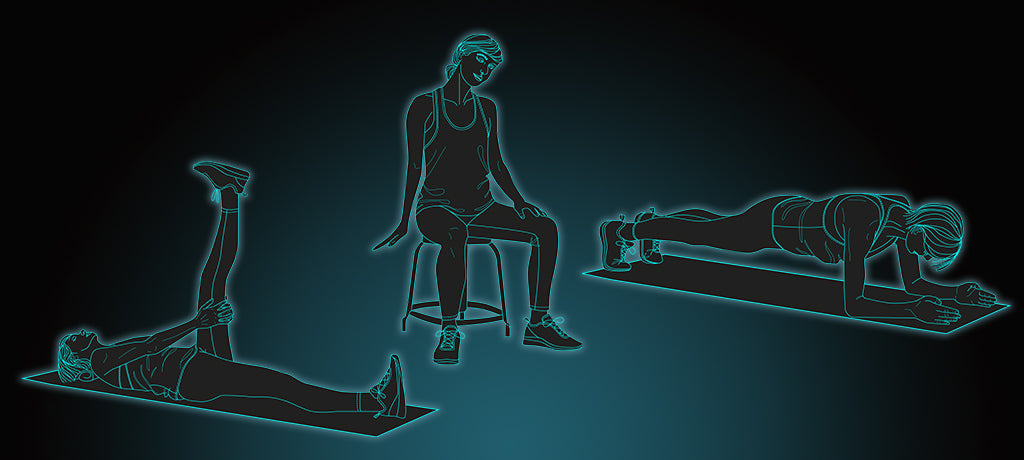
Did you know that prolonged sitting is just as harmful as smoking? The headlines about recent studies on our sitting habits are alarming – and yet we practically insist on it. Meanwhile, prolonged sitting is now considered the fifth leading cause of death.
The issue of sitting is also difficult because sitting has become an integral part of our culture. And as is the nature of culture, we pass it down from generation to generation, so we are already teaching even the youngest members of our society to sit as still as possible. For this reason, preventative measures should begin in childhood and adolescence – and this leads us to a bold hypothesis: Could the current situation of homeschooling offer an opportunity for preventing the health consequences of prolonged sitting in children and adolescents?
But let's start at the very beginning. Because to understand why sitting is so harmful to us and why we should seriously rethink the way children are taught to sit, we first need to take a little detour into history. Marty McFly is ready! Are you? Then let's go:
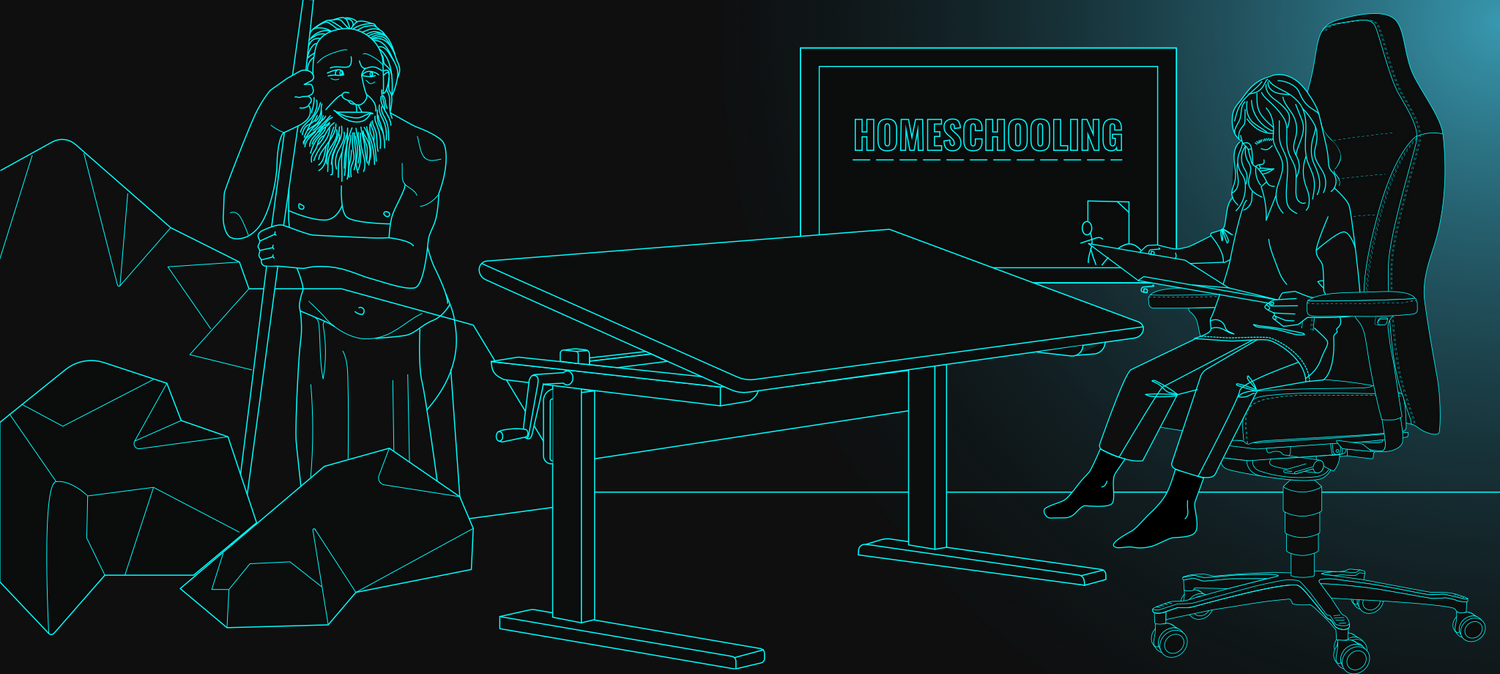
A real game changer: walking upright and no chair in sight.

When evolution enabled humans to develop from Homo erectus to modern humans around 300,000 years ago, our species gained a significant level up with the adoption of bipedalism . However, it took a long time before humans created seating. While seating resulted directly from our transition to a sedentary lifestyle, we as Homo sedens, or sedentary humans, have only existed for about 12,000 years. This is when the first work stools appeared. Proper sitting, however, remained primarily reserved for high-ranking individuals such as pharaohs and kings at that time. Later, the circle of people with the "right to sit" expanded to include princes, knights in knights' halls, and the civic guard. It wasn't until the 16th century that sitting became fashionable among the rising middle class, and only another 200 years later was it adopted by the general population.
Michael Tonet's invention of bentwood furniture sparked a veritable revolution in the market. Thanks to its simple construction, he designed chairs as easy-to-assemble kits for everyone . This allowed chairs to be produced and shipped cheaply in individual parts, making them incredibly easy to assemble on-site. Suddenly, everyone could afford his famous Viennese coffeehouse chair, "Chair No. 14." Since then, we've been sitting constantly, regardless of age.
Even children are already feeling the health effects of sedentary lifestyles.
In a very short time, a culture of sitting has become established, and industrialization acted as an additional catalyst. We have only been sitting correctly for about 200 years, and evolutionarily we are far from having adapted to a sedentary existence like sloths . People in industrialized countries now sit for up to 15 hours a day. Sitting is something that has to be painstakingly learned, and so we force toddlers to sit still even before they can properly speak, read, or write. At the same time, however, we also suppress their natural urge to move, until they can no longer recognize it as a sedentary human being. At the latest, through the institutionalization of sitting in schools , we force them into a sedentary culture and thus inevitably lead to the resulting physical damage.

An analysis of children's sitting time in 2017 revealed that children and adolescents aged 4 to 20 already sit for 10.5 hours per day on weekdays and 7.5 hours on weekends. According to the analysis, the number of hours spent sitting increases with each grade level, and overall, the surveyed age group spends 70% of their waking hours sitting. While children and adolescents are more active on weekends, an increasing number of leisure activities, such as gaming, take place while sitting.
Prolonged sitting has a significant impact on secondary illnesses such as high blood pressure, chronic muscle tension, bulging discs, arteriosclerosis , and others, which are increasingly occurring even in young people. We constantly talk about the importance of a healthy diet, especially for children and adolescents, to prevent these illnesses. However, a closer look at the consequences of sitting and its role in these problems shows that this is not enough. Prevention and prophylaxis in childhood and adolescence must absolutely include maintaining a love of movement and promoting awareness of proper sitting posture.
Homeschooling as a game changer for ergonomic learning?
That's easy to say during a pandemic. Because of self-isolation and avoiding contact, children and teenagers are spending even more time at home. Their bodies and minds suffer, and homeschooling is the final straw for some families. Yet homeschooling could be an opportunity to promote learning in new and more ergonomic ways. Tables and chairs in schools are neither ergonomic nor comfortable. Even today, half the students slouch over their notebooks and books at some point during the day. Just like in the past, teachers admonish the children to sit up straight to prevent postural problems. But classroom seating doesn't promote fatigue-free sitting, and children, too, eventually adopt a protective posture. Incorrect sitting is exhausting ; it strains and fatigues the body, right down to the brain. These are signs that the child's posture is actually too restricted.
In contrast, a child's bedroom offers opportunities for an ergonomic learning space and alternative positions such as standing, lying down, or sitting on the floor. Anyone who thinks learning is only possible while sitting is mistaken. A change of position can sometimes work wonders, especially if there are already signs of restlessness, such as fidgeting or decreased concentration. We have therefore compiled some tips for setting up an ergonomic learning space at home:
- Ergonomic table with tilting tabletop
 We've explained how to set up an ergonomic computer workstation many times, and you can find information about it all over the internet. But what about a study space where writing and reading take place? Honestly, it's the same principle. The monitor's position relative to the viewing angle is originally based on how we read a book most effectively. Children who draw, craft, or write at a desk shouldn't be physically restricted in their work and therefore benefit from ergonomic furniture just as much as adults. Since children are still growing, a height-adjustable desk is worthwhile in three ways: 1. It can be adjusted to the child's height while seated. 2. It grows with the child and is therefore a long-term investment . 3. The desk can also be used while standing, which is a welcome change from working while seated. A tiltable tabletop is a further advantage , as it prevents a hunched posture over books or notebooks. At this point, we can confidently recommend the ergonomic desks from moll . Thanks to their modular design, the tables can be adapted to the ever-changing needs of children (drawing, writing, learning, computer use, etc.). Those who don't have such a tabletop can at least get some support with a book stand . Foldable versions can even be taken to school.
-
Ergonomic gaming chair

A gaming chair in a child's bedroom? For many parents, that's probably unimaginable at first, because most gaming chairs are standardized and therefore not suitable for growing children. This is because most gaming chairs on the market aren't truly ergonomic. However, gaming chairs like the GAMECHANGER offer a counterpoint. Available in three different sizes , it provides all the ergonomic adjustments of a proper ergonomic office chair . Thanks to its synchronous mechanism , it allows for dynamic sitting and constant position changes.

Thanks to the precise locking mechanism of the backrest and its height adjustment, the GAMECHANGER gaming chair in size S/M, together with the low gas spring, is already suitable for children and teenagers from about 140 cm tall and grows with them for many years.
Dangerous rocking maneuvers are now a thing of the past : Thanks to a loose backrest, those eager to move around can lean forward and backward as much as they like. While there are also ergonomic desk chairs specifically for children, these often lack armrests , even though children also benefit from their function of relieving strain on the neck and shoulders.
Since kids' early passion for gaming is often hard to switch off, it's all the more important to provide seating that offers preventative support against generally harmful sitting habits . An ergonomic chair makes sitting during homeschooling even more comfortable. The GAMECHANGER thus kills two birds with one stone, making it suitable for both studying at a desk and leisure time. A major advantage: The GAMECHANGER gaming chair can be individually configured thanks to its various settings . The breathable synthetic leather is also particularly skin-friendly and free of toxic substances.

|
Editor's tip: An ergonomic study space is only half the battle. The University of Marburg has developed workshop materials on learning and movement , originally intended for use in schools. However, many of the exercises can also be integrated into homeschooling and homework. Movement breaks are a real game-changer for improving learning and memory skills. Movement sequences during a study session also help the brain to forge new connections. Sources: Hermann Brauer: The creation of a chair. In: Mitteilungen des Württembergischen Kunstgewerbevereins, 2nd year 1903–1904, pp. 60–64. Hansjürgen Bulkowski: Love for the Subject. The Things We Live With., Berlin 2010, pp. 103–107. https://wirtschaftslexikon.gabler.de/definition/ergonomie-33057 https://www.uni-marburg.de/fb21/ifsm/ganztagsschule/schulmaterial/workshop https://dvgs.de/de/aktuelles/749-bewegt-euch-kinder-sitzen-fast-70-prozent-ihrer-wachen-zeit.html https://www.aerztezeitung.de/Panorama/Deutschland-bleibt-sitzen-231436.html |