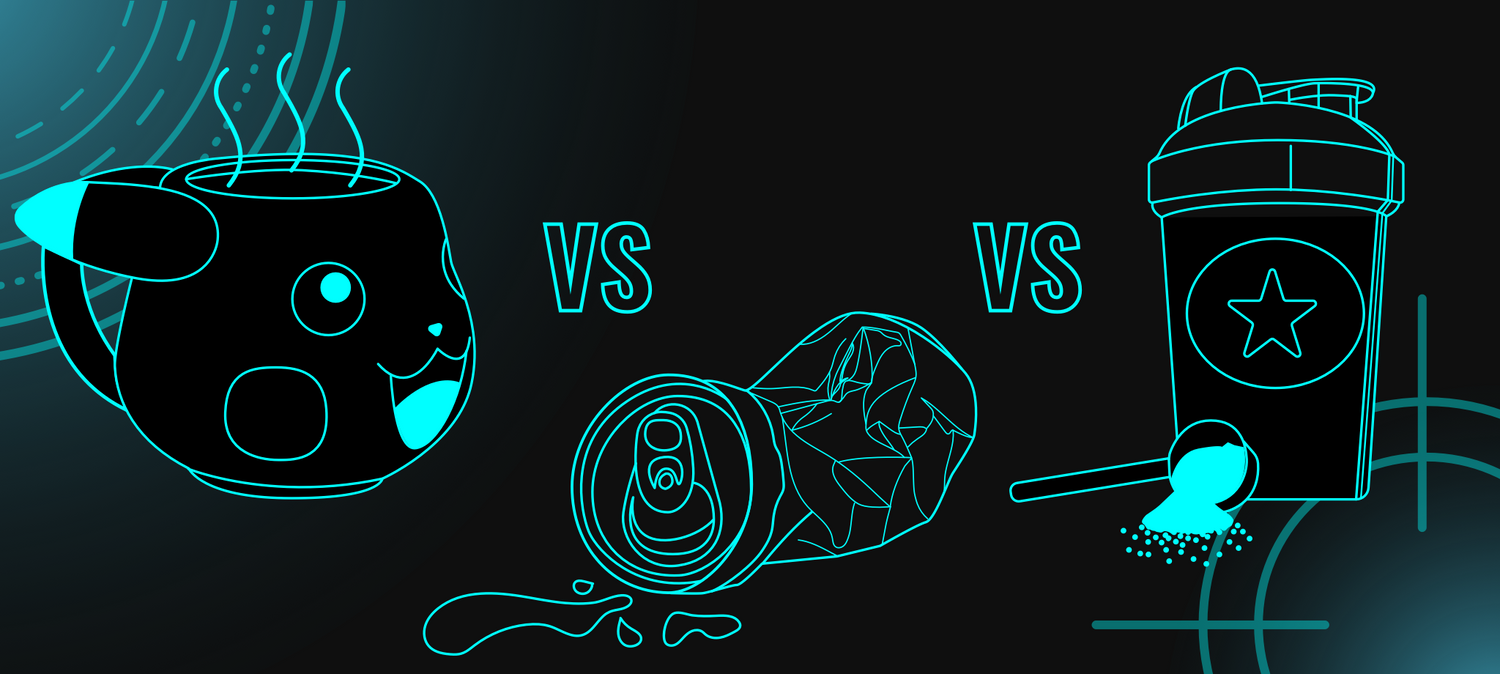
“Caffeine is unhealthy!”, “Caffeine boosts performance!”, “Energy drinks cause heart attacks!” – Many persistent rumors surround caffeinated foods and drinks . From healthy to unhealthy to dangerous in the form of energy drinks, everything is represented. But what is the truth? And are gaming boosters safer than conventional energy drinks?
It's often reported that caffeine drinks have a different effect than energy drinks, at least on social media. Instead of providing a stimulant, they supposedly increase concentration and thus performance in games, or so the assumption goes, which many claim to have experienced themselves. I investigated this to find out if it's a placebo effect or if caffeine actually improves concentration. But also very importantly: Are these drinks really that harmful, or is it just fear-mongering? To be honest, I was surprised by some of the findings in my research . You'll find out why later in the article. But let's start at the beginning:
Nerve-wracking: This is what caffeine does to your body

Is your first stop at the office in the morning also the coffee machine? In the form of tea, coffee, energy drinks, mate, guarana, or cola, many people consume caffeine almost daily: it 's the most frequently consumed pharmacologically active substance , without us giving much thought to the fact that it actively influences our psyche . Over a cup of the brown brew made from ground beans, we like to chat with colleagues and wake up together. Focus without coffee? Unthinkable for many.
The truly invigorating effect of caffeine is well-documented in numerous studies . Even in small doses, caffeine is a stimulant that primarily stimulates our mood and motivation . In high doses, however, it also has a stimulating effect on, for example, the respiratory center and the cardiovascular system. Generally, we consume caffeine in doses that are not dangerous. However, since caffeine easily crosses the blood-brain barrier, it exerts its effects in our central nervous system. I was surprised, because we actually benefit from our morning coffee in…
The disadvantages, however, are...
… less dexterity, because the complex visuomotor coordination deteriorates.
… a habituation effect, because we need more and more caffeine to achieve an increase in performance.
… Withdrawal symptoms upon abstinence after regular consumption.
… a short-term increase in blood sugar and insulin levels, as well as cholesterol and blood pressure.
For healthy individuals, caffeine is generally harmless, but the dose makes the poison: even a single glass of cola can cause nervousness and significant sleep disturbances in children . Adults, for example, don't need nearly as much caffeine to achieve a performance-enhancing effect as one might think. Athletes who rarely consume caffeine can achieve this effect with a dose of just 3-5 mg/kg of body weight. A cup of espresso contains an average of 80 mg , and caffeine can be fatal to humans at an average dose of 10 g – equivalent to approximately 100 cups of coffee. However, depending on tolerance and fitness level, between 5 and 30 g can also be dangerous. Therefore, the amount of caffeine a person can tolerate depends on their body weight and can be calculated to a certain extent.
Caffeine overload: Don't consume energy drinks without thinking.

It's not that simple. When we consume caffeine through natural sources like tea and coffee, it occurs naturally and in harmless amounts. The European Food Safety Authority considers 400mg of caffeine spread throughout the day (approximately 4 cups of coffee) to be safe, but a single dose of 200mg should not be exceeded. So, anyone who drinks a lot of coffee throughout the day will primarily be spending a lot of time in the bathroom. However, things become more problematic when energy drinks enter the picture . A can contains between 150 and 400ml of beverage. The caffeine content per can can range from 30mg to 150mg – on average, it's between 100mg and 130mg, depending on the brand. The problem is that people usually finish a can, and often don't stop at just one. Added to this are the additives , which can also pose a problem. Because research is still not in agreement on the nature of the interactions .
One of the best-known is probably taurine – actually a substance that the human body produces itself from the amino acid cysteine, which is why taurine supplementation is n't really necessary . Taurine is primarily involved in the development of the central nervous system and also in regular heart function. Another substance, on the other hand, is myo-inositol (inositol), an alcohol that the body produces itself and is important in insulin metabolism. It is used in fertility treatment for PCOS and in the treatment of obesity and pre-diabetes because it supports the insulin sensitivity of cells, thus enabling better sugar metabolism. And last but not least – very important: sugar. If you're now wondering why this stuff is mixed into energy drinks – I wondered that too and couldn't find any significant, verifiable reason .
Taurine is said to further boost concentration and metabolism—at least in combination with caffeine. So far, this effect hasn't been definitively proven. However, if it were true, it would place a double burden on the cardiovascular system , since caffeine alone already does its fair share. Add to that the amount of sugar, which also provides energy for the body, and you can imagine where this is headed. Sugar, too, can be stimulating in large quantities. But everything in this area is speculative. And speculation means: better safe than sorry. Why?
The extreme energy crashes experienced after consuming energy drinks could already be an indication of the strain the combination of substances puts on the body. Sugar and caffeine seem to take effect particularly quickly when combined. However, since research on this topic is still very limited, various institutions are urging people to consume energy drinks in moderation . The stimulating effect of the combination of taurine and caffeine, in particular, is not well understood – while reality repeatedly gives cause for warning. Unfortunately, heart attacks and sudden cardiac deaths have already been observed in connection with high consumption of energy drinks, even among young, healthy individuals .
More control thanks to Gaming Booster

At first glance, gaming boosters seem to solve the problem of energy drinks. Firstly, they come in trendy flavors and have rather fancy names that suggest a higher level of performance in gameplay. Secondly, they suggest control, since you mix the powder yourself with water in a shaker according to the manufacturer's instructions. Some loyal fans of gaming boosters regularly report that they primarily experience them as an increase in concentration , rather than as a stimulant like energy drinks. The source of this subjective feeling is not immediately explainable by the stimulating ingredients. Because:
- Gaming boosters hardly differ in composition from energy drinks.
- The most common components are caffeine , and taurine and inositol are also used as additives .
- Marketing: Both energy drinks and gaming boosters may contain added vitamins to give the impression of a healthy product.
But here's the thing: Many gaming boosters contain significantly more caffeine per serving than a regular energy drink . While an average energy drink contains about the same amount of caffeine as a cup of coffee, the recommended serving of a gaming booster can easily contain 250mg per serving . That's more than the recommended single dose from a health perspective, and that's precisely what makes them so problematic. Very few people actually measure the powder meticulously, resulting in immeasurable variations in the actual composition per serving. This creates a false sense of security through the apparent control over the dosage, which you don't actually have unless you follow the instructions exactly. I mentioned the stimulating effect of caffeine—or, as it's commonly known, its energizing effect—at the very beginning, which brings us to this point: With gaming boosters, the likelihood of overdosing and therefore becoming jittery and nervous is definitely higher than with a can of regular energy drinks.
The only difference: Some gaming boosters contain sweeteners instead of sugar . This means that a key energy source is missing, and there's no reaction between sugar and caffeine that could overstimulate you. However, since these boosters generally contain too much caffeine, this difference doesn't make a difference in terms of potential risks. And there's another potential side effect:
Excessive caffeine consumption can lead to a feedback effect . Caffeine stimulates the release of the stress hormones cortisol and adrenaline in the adrenal glands, increasing heart rate and putting the body on high alert. A natural reaction in this situation would be to run for your life – a natural escape response that helps reduce stress hormones . However, when you're sitting at your computer, the opposite happens. The body remains under stress, and the initial performance peak is followed by a significant crash. Concentration and energy levels plummet. This is yet another reason to avoid gaming boosters.

So no caffeine at all now, or what?
The dose makes the poison. At GAMECHANGER, we love our morning coffee, and gameplay without massive fatigue setbacks is also very important to us. However, as a company with a passion for ergonomics, our credo is to prevent harm to the body, not cause suffering. That's why we place great emphasis on ensuring that you maintain a clear mind through proper posture and avoid tension that disrupts your focus. Furthermore, the right choice of power foods, as well as a comfortable and pain-free sitting position in yourgaming chair , will support you in maintaining your cognitive performance . This way, you shouldn't even need to resort to gaming boosters.
If you still enjoy caffeinated drinks, you should make sure they don't contain any artificial additives for which no benefit has been proven and whose harmfulness cannot be ruled out. Coffee, tea, mate, and guarana naturally contain caffeine, so you usually don't exceed the recommended amount. Just like with soda, it's the quantity that matters with energy drinks. Having a can now and then isn't a problem—as long as you make sure you don't exceed the total daily intake of approximately 3-5 mg/kg of body weight . For a young adult weighing 70 kg, that would be 210-250 mg. Obviously, drinks without added sugar are always preferable. The main difference between energy drinks and gaming boosters is marketing, which is why you can also enjoy these occasionally, as long as you don't exceed the maximum amount of caffeine.